The big shift: “Trust isn’t enough anymore”
In the last few years, something quietly changed in global food trade: “trust” is no longer enough. Regulators, retailers, and consumers increasingly ask for verifiable proof, where an animal was born, how it moved through the chain, what it was exposed to, and under what conditions it traveled. Not because the industry is “bad”, but because the stakes are high: food safety events happen, rules evolve, and markets react fast.
And then there’s the most powerful pressure of all: the public “Right to Know.” People don’t just want a label, they want a story that holds up when questioned. They want to know the origin, the welfare standards, the environmental footprint, and whether claims are backed by evidence. In that world, the winners won’t be the farms with the loudest promises, but the ones with the clearest proof.
That’s why “putting a herd in the cloud” isn’t a gimmick. It’s the modern way to turn daily farm reality into traceable facts: not to create more bureaucracy, but to protect farmers, to protect markets, reduce costly uncertainty, and build confidence that scales.
What’s at stake?
This isn’t only about compliance. It’s about economics, what you lose when proof is missing, and what you gain when proof is effortless. When a buyer, auditor, or regulator asks a simple question, the outcome often decides whether you get paid faster, sell at a premium, or get stuck in delays and disputes.
- Market access: The best contracts increasingly go to suppliers who can demonstrate origin, welfare, and environmental claims, fast, consistently, and without manual detective work.
- Risk reduction: Outbreaks, recalls, and investigations are expensive. The difference between a controlled incident and a chaotic one is usually traceability speed and data quality.
- Lower operational cost: Missing data creates hidden work, calls, spreadsheets, photos, and last-minute paperwork. Automated records reduce labor, errors, and rework.
- Fewer disputes: When transport conditions, timing, and chain-of-custody are provable, there’s less argument about responsibility, and fewer rejected loads and payment hold-ups.
- Better product consistency: Welfare isn’t only ethics, it’s quality. Stress during handling and transport can reduce meat quality and consistency, which shows up directly in margins.
In short: proof isn’t paperwork. Proof is a profit lever.
The modern requirement: end-to-end proof from birth to plate
Once you see what’s at stake, the “new requirement” becomes obvious: it’s no longer enough to say we do the right thing. You need to show it, end to end, in a way that survives questions.
Not a single document. Not a one-time certification. A chain of evidence that connects daily reality on the farm to what the market expects downstream.
Here’s what that proof has to cover:
- Identity: Which animal, exactly?
- Origin: Where it was born and raised.
- Movements: Where it went, when, and why.
- Health & treatments: Vaccinations, illness events, medications, withdrawal periods.
- Handling & welfare: Practices and conditions that affect wellbeing and quality.
- Transport conditions: Timing, route, stops, temperature/heat stress risk.
- Chain of custody: Who had responsibility at each handoff.
- Batch linkage: How individual animals map to lots, processing, and distribution.
The key shift is this: proof is built from events, not from spreadsheets. A spreadsheet is a summary someone made later. An event is a fact captured when it happened, time-stamped, attributable, and consistent.
That’s the foundation of “cloud cows”: turning real-world actions into verifiable events, so traceability becomes a byproduct of operations, not an after-the-fact scramble.
The fragile link: reality on the ground
The reason many traceability initiatives fail isn’t ambition, it’s reality. Farms aren’t data centers. They’re living systems, spread across distance, weather, people, animals, and machines that don’t always cooperate.
A few things make “end-to-end proof” harder than it sounds:
- Connectivity isn’t guaranteed. Pastures have dead zones. Mobile networks fluctuate. Power can be unstable. If your system needs perfect internet to be truthful, it will eventually lie.
- Work happens offline. Treatments, movements, loading, weighing, these moments don’t wait for dashboards. If data capture is slow or complicated, it won’t happen consistently.
- The chain is fragmented. Farm management tools, transport records, slaughterhouse systems, and compliance platforms rarely speak the same language. Evidence gets scattered across apps, emails, and photos.
- “Cloud status” isn’t the same as “physical truth.” A platform can show “received” while a gate was never scanned, a truck was delayed, or an animal never arrived where the record says it did.
- Manual proof is expensive. When audits or questions arrive, teams often assemble evidence by hand. That’s not a system, it’s a scramble.
This is the core problem: the market wants certainty, but the field is full of uncertainty. So the winning approach isn’t to pretend the ground is perfect, it’s to design for imperfection, and still produce trustworthy proof.
The operating model: from reality to proof (without the paperwork)
To make traceability work in the real world, you don’t need more forms. You need a simple loop that turns daily reality into reliable proof, automatically, as a byproduct of operations.
It comes down to three ideas:
- Capture what matters: a small number of key moments that define the story of an animal and a shipment.
- Make it trustworthy: not just “data entered,” but information that can stand up to questions later.
- Close the loop: when something is missing, late, or risky, the system should make that visible early, before it turns into cost, dispute, or rejection.
The goal isn’t a perfect digital twin of the farm. The goal is proof that holds up, built from reality, not from after-the-fact paperwork.
The concrete foundation: identity per animal
Everything becomes easier, and more valuable, once each animal has a clear, verifiable identity. Without it, you’re tracking averages and batches. With it, you’re tracking reality.
This is where the “cloud” stops being a metaphor. A herd in the cloud simply means this: each animal becomes a traceable entity, not an anonymous unit in a supply chain. And once identity exists, everything else can finally sit on solid ground: compliance, quality, sustainability, and trust. The question is no longer whether you can prove your story, but how fast you can do it when it matters.
The next challenge: turning identity into a story that holds up
A per-animal identity is the foundation. But the real difference comes next: can you turn that identity into a story that still holds up when someone starts asking hard questions?
Because the moment you can point to one animal, the follow-up questions appear automatically:
- What happened to this animal, step by step?
- Under what conditions did it travel?
- Which health and welfare indicators are provable?
- Which claims are marketing and which are evidence?
And if something goes wrong, how fast can you act precisely without punishing everyone?
And here’s the second layer people often underestimate: an animal is rarely “alone.” In practice it moves through the chain as part of a batch (transport, delivery, processing). That batch becomes an additional control layer: the same actions, timelines, and conditions apply to multiple animals at once. So identity isn’t just traceable, it becomes cross-verifiable.
If the individual identity is true, it must fit inside the batch story. And if the batch story is true, it reinforces the individual identity. That mutual consistency is what makes evidence strong: not one isolated datapoint, but a narrative that checks out internally and is therefore much harder to falsify.
This is the moment when traceability stops being a report and becomes an operational capability: something you don’t scramble to reconstruct during an audit, but something you build automatically, every day.
Where things usually break: the “last mile” between reality and systems
On paper, traceability sounds straightforward: collect data, store it, share it. In reality, it usually fails in one painfully specific place: the last mile between what happens in the physical world and what ends up in software.
That gap shows up everywhere:
- A real event happens, but it’s logged late, or not at all.
- Two systems “agree” in theory, but don’t match in practice.
- Data exists, but can’t be trusted because it’s easy to edit, duplicate, or lose.
- A chain partner asks for proof and the team starts hunting screenshots, spreadsheets, and WhatsApp messages.
And the irony is: most of the cost isn’t in the technology. It’s in the uncertainty, the time wasted reconciling, the disputes, the rejected loads, the overreactions when something goes wrong.
This is why “connecting a herd to the cloud” isn’t really about cows. It’s about closing that last mile, so physical reality becomes digital evidence reliably, without turning the farm into an admin office.
The opportunity: proof that creates value (not paperwork)
Once that “last mile” gap is closed, something interesting happens: traceability stops feeling like compliance and starts behaving like an advantage.
Because proof travels faster than explanations. And in modern food chains, speed and certainty create value:
- Faster decisions: less waiting, less back-and-forth, fewer “hold” situations.
- Cleaner trade: smoother audits, fewer surprises, fewer last-minute document scrambles.
- Smaller blast radius: when an issue appears, you can act precisely instead of shutting everything down.
- Stronger positioning: welfare, sustainability, and origin claims become credible, and credibility is negotiable value.
- Lower hidden costs: fewer disputes, fewer rejected loads, fewer hours lost reconciling mismatched systems.
The best part: the goal isn’t to “add work.” The goal is the opposite, to make proof a byproduct of operations. So when someone asks, “Can you show me?” your answer isn’t a project. It’s a click.
Where OuViTel fits in: connecting reality to the cloud (and back)
This is exactly the space OuViTel operates in.
Not as “another dashboard,” and not as a generic farm management tool. OuViTel is built for the hard part: connecting physical reality to cloud workflows and connecting cloud decisions back to the physical world.
In practice, that means three simple outcomes:
- Hardware becomes speakable: devices, identifiers, scanners, sensors, printers; whatever is used on the ground, can reliably feed the chain with real signals.
- Systems stop being islands: data doesn’t have to live in one place or one vendor. Different platforms can align around the same operational truth.
- Proof becomes a byproduct: instead of building evidence after the fact, evidence is produced naturally while work is being done.
If you’re aiming for traceability that holds up under “Right to Know” pressure, without turning the operation into bureaucracy, this is the missing link: a bridge between the physical chain and the digital chain.
The takeaway: “cloud cows” aren’t a joke anymore
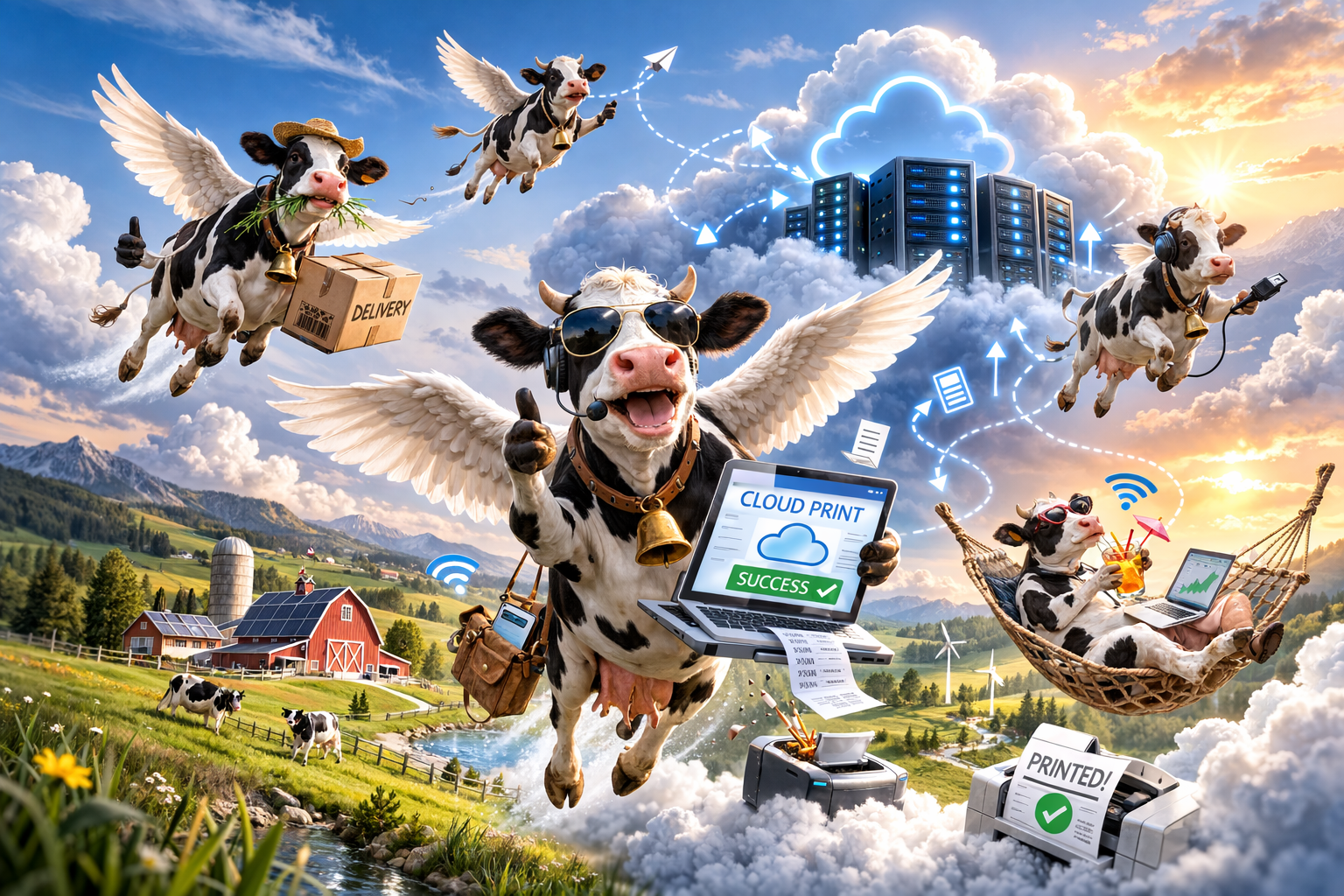
The flying-cows image is funny, but the idea behind it is serious.
“Cloud cows” simply describes a new reality: in modern trade, food is expected to come with evidence. Not just a label. Not just trust. Evidence that can be checked, shared, and defended when it matters.
And that’s good news, because when proof is built into daily operations, it doesn’t just reduce risk. It creates clarity. It protects good producers. It prevents overreactions. And it turns responsible practices into something the market can actually reward.
If you’re exploring how to bring that kind of proof into your chain, without adding friction, OuViTel can help you map what’s possible, what’s realistic, and what would create the fastest return.
Want to talk? A conversation is usually enough to identify where your “last mile” is and what it would take to close it.
Want to map your “last mile”?
Tell us what you track today, who you share it with, and where it breaks. We’ll help you see the fastest path to proof that holds up.
Contact OuViTel →